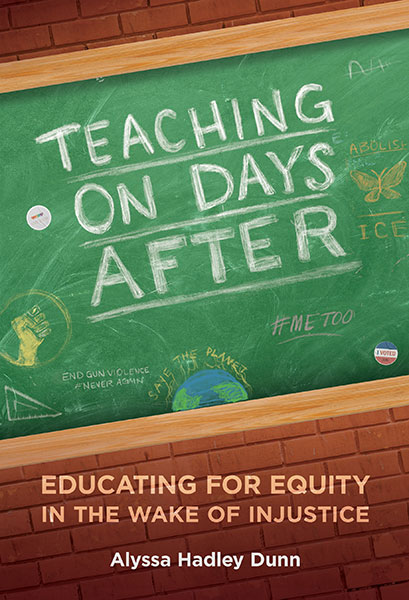
Support for teachers and leaders navigating “the day after”
When tragedy strikes, elections reshape communities, or injustice makes headlines, students need more than silence. Days After Pedagogy is a framework for teachers and leaders who refuse to return to business as usual — and who believe the classroom can be a site of healing, honest dialogue, and justice-oriented action.
A companion resource to Teaching on Days After: Educating for Equity in the Wake of Injustice (First and Second Editions) by Dr. Alyssa Hadley Dunn (Teachers College Press, 2021 & 2026).
What is Days After Pedagogy?
Days After Pedagogy (DAP) is a justice-oriented and asset-based framework for teaching in the wake of major societal events, tragedies, or injustices. It represents a “pedagogical refusal” to maintain “business as usual” when the world is in upheaval, acknowledging that these critical moments are the very context in which students live and learn. Rooted in the understanding that education can never be neutral, DAP rejects silence as a choice that often upholds a harmful status quo. Instead, it fosters criticality – the ability to read power and oppression – and centers student agency, transforming the classroom into a humanizing, trauma-responsive space where youth are empowered as active participants and change agents in their own lives.
Examples of Days After Pedagogy
Ethnodrama
Ethnodrama is “a written play script consisting of dramatized, significant selections of narrative collected from interview transcripts, participant observation field notes, journal entries, personal memories/experiences, and/or print and media artifacts” (Saldaña, 2005, p. 2).
Types of days after
A "Day After" occurs whenever a major event interrupts the lives of our students and the communities we serve. These moments demand a "Days After Pedagogy" (DAP): a commitment to humanizing dialogue and sociopolitical awareness that resists the pull towards a "business as usual" praxis. Explore the categories below to see how different types of events necessitate unique pedagogical responses.
ElectionsMass TragediesEnvironmental DisastersGender InjusticeRacial InjusticeRacial ViolenceWhite Supremacist EventsImmigration Injustice
DAYS AFTER ELECTIONS
When election results reshape the world students live in, classrooms cannot pretend it's business as usual. Days After Elections explores how teachers have responded to moments of political upheaval - from crafting "shields of courage" with 4th graders to switching morning meetings to Spanish so students could name their fear in their own language.
DAYS AFTER MASS TRAGEDIES
Gun violence has become so routine that some students no longer remember specific shootings. On days after instances of mass tragedies, teachers try to create space to process tragedy as they try to be present with students in the aftermath of collective shock and grief.
DAYS AFTER ENVIRONMENTAL DISASTERS
Environmental disasters are shaped by neglect, policy, and injustice. Days After Environmental Crises looks at how teachers connect ecological and climate events to the broader social and political forces that determine who bears the burden of our collective environmental impact.
DAYS AFTER GENDER INJUSTICE
When stories of assault and discrimination dominate the news, students turn to the adults around them for context and support. Days After Gender Injustice explores how teachers have led honest conversations about consent, belief, and accountability from the Kavanaugh hearings to the everyday dynamics students navigate on social media and with their family and friends.
DAYS AFTER RACIAL INJUSTICE
If teachers don't address racial injustice, students will through social media, often without context and sometimes without safety. Days After Racial Injustice centers the experiences of students and teachers navigating moments when Black lives, immigrant lives, and the lives of the marginalized are publicly disregarded, and asks what it looks like to refuse silence.
DAYS AFTER RACIAL VIOLENCE
When racial violence makes national headlines, students of all backgrounds are affected - whether they see themselves in the victims or have never been asked to reckon with why it matters. Days After Racial Violence examines how teachers refuse silence and bring the ongoing struggle for Black lives and racial justice into honest classroom conversation.
DAYS AFTER WHITE SUPREMACIST EVENTS
From Charlottesville to the Capitol, white supremacist events force teachers to name what they are seeing even as administrators, colleagues, and community members may prefer they look away. Days After White Supremacist Events explores how teachers create space to examine hatred, history, and the democratic values students are asked to uphold.
DAYS AFTER IMMIGRATION INJUSTICE
Recent federal immigration policy, and the increased presence of ICE officers across the nation constitute an existential fear for immigrants, children of immigrants, and their friends and neighbors. Days After Immigration Injustice follows teachers who refuse to let federal rhetoric go unexamined, building classrooms where students can name their fear, access their rights, and find their voice.
Activities and resources
A curated set of protocols and discourse supports that can be adapted across event types.
Classroom protocols
More from the blog
Lorem ipsum dolor sit amet, consectetur adipiscing elit. Sed do eiusmod tempor incididunt ut labore et dolore magna aliqua.
About the author

Contact
For professional development workshops, speaking engagements, or collaboration: Alyssa Hadley Dunn
Many of the community resources hosted on this site were originally created and contributed by the members of the Facebook Group Teaching on Days After: Dialogue & Resources for Educating Toward Justice.